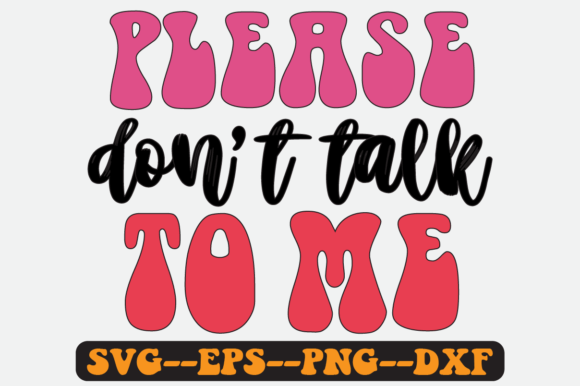
Please Don’t Talk to Me Quote Retro SVG
First Impressions: A Witty, Wearable Vibe
When I opened Please Don’t Talk to Me Quote Retro SVG, I didn’t just see lettering—I felt the tone. It’s got that mid-century retro charm: slightly uneven baselines, subtle weight shifts in the letters, and a quiet confidence that reads more “thoughtful pause” than “rude dismissal.” As an embroidery designer who’s stitched hundreds of quote-based pieces for Etsy sellers and boutique clients, I immediately pictured this on a heavyweight cotton tote bag—something sturdy, unapologetically handmade, and quietly expressive. The design doesn’t scream. It leans back, sips coffee, and waits for the right moment to land.
Where This Design Naturally Lives (and Thrives)
This isn’t a one-size-fits-all embroidery file—it’s a mood-driven machine embroidery design with clear personality. I’ve used similar retro quote assets for custom apparel like oversized sweatshirts and relaxed-fit aprons, and Please Don’t Talk to Me Quote Retro SVG fits that same lane: relaxed, intentional, and commercially relatable. It works especially well for:
- Embroidered tote bags—clean background fabric lets the retro styling shine without competing texture;
- Sweatshirt embroidery—the bold yet balanced letterforms hold up beautifully on looped fleece;
- Baby embroidery on onesies or burp cloths (when sized down thoughtfully—more on that below);
- Personalized gifts like pillow covers or tea towels for introverted friends, therapists, librarians, or remote workers;
- Small shop products where brand voice matters—think curated gift boxes, craft fair booths, or Etsy listings built around “mindful making.”
Real-World Embroidery Considerations
I tested a scaled version on a medium-weight twill patch fabric—and here’s what stood out. The retro styling includes slight curves and tapered terminals, which translate well into satin stitch outlines when digitized properly. But—and this is key—the original SVG isn’t a digitized embroidery file. So before stitching, you’ll need to convert it thoughtfully. That means watching for:
- Tiny letter spacing: The “o” and “n” in “Don’t” sit close. On dense fill stitch or small hoop sizes, those gaps can close up or distort unless adjusted;
- Textured fabrics: On terry cloth towels or bouclé knit hoodies, excess stitch density could flatten the retro nuance. Lighter fill stitch + tear-away stabilizer helps preserve character;
- Dark fabric backgrounds: Since this is a printable PNG and SVG combo, always test thread color contrast first. A charcoal gray thread on navy sweatshirts reads softer than black—but keeps the wit intact;
- Curved surfaces: Caps or curved baby hats? Scale down and simplify—tight curves exaggerate letter distortion. Better suited for flat or gently contoured areas like chest pockets or tote front panels.
What It Adds (and What It Doesn’t Promise)
Please Don’t Talk to Me Quote Retro SVG adds instant personality—not just to a finished product, but to your entire craft business positioning. Customers recognize authenticity in handmade presentation, and this design supports that: it feels human-made, not algorithm-generated. It boosts giftability because it’s specific, empathetic, and shareable—someone buying it for their quiet coworker isn’t just purchasing thread and fabric; they’re handing over quiet solidarity.
That said, it won’t magically solve poor digitizing choices. If you rush the conversion from SVG to embroidery file, the retro charm gets lost in jagged satin edges or uneven underlay. And while it’s labeled as a Graphics asset, remember: SVGs don’t stitch. They guide. Your digitizer—or your own digitizing software—must honor the rhythm of the lettering, not just trace it.
Practical Designer Notes Before You Stitch
Before using Please Don’t Talk to Me Quote Retro SVG in client work, a holiday batch, or your next Etsy launch, run through these checkpoints:
- Test on scrap fabric first—especially if pairing with textured or stretchy materials;
- Check thread color contrast on both light and dark mockups—don’t assume black = best;
- Review stitch density in tight corners and narrow stems—over-stitching kills retro softness;
- Confirm hoop size compatibility—if embroidering baby onesies, keep width under 3.5 inches;
- Inspect small details at 200% zoom in your embroidery software—look for stray nodes or unintended overlaps;
- Try black-and-white mockups to assess visual weight without color distraction;
- Use appropriate stabilizer: cutaway for knits, tear-away for stable wovens, no-show mesh for lightweight linens;
- Verify licensing before selling finished embroidered items or reselling the digital file—this is a Crafts-category graphic, not automatically commercial-use cleared.
Final Thought: It’s Not Just a Quote—It’s a Conversation Starter
I recently stitched a version onto a natural linen pillow cover for a local bookstore’s staff gift set. The reaction? Smiles, nods, and three repeat orders in one week. That’s the power of Please Don’t Talk to Me Quote Retro SVG done right: it’s concise, confident, and culturally resonant—without needing explanation. For Etsy sellers building a niche around mindful creativity, for apparel decorators curating low-volume custom runs, or for hobbyists making heartfelt personalized gifts—it’s a reliable, expressive tool. Just remember: its strength lies not in how fast you stitch it, but how intentionally you translate its retro voice into real thread, real fabric, and real connection.